
News
Latest posts from the competitions' RSS feeds.
Sustainable Innovative Mobility Challenge Formula Bharat 2027

Calling Formula Bharat teams to look beyond vehicle performance. Rethink material choices, manufacturing processes, and resource use across the vehicle lifecycle.
Submission closes in
About The Challenge
The Sustainable Innovative Mobility Challenge (SIMC) is a Formula Bharat initiative, with WRI India as its Knowledge Partner. It encourages student teams to bring sustainability into the vehicle design and development process through practical, evidence-based solutions. The challenge recognises that the environmental footprint of a vehicle extends beyond its energy source or on-track performance. It also depends on the materials selected, the way components are manufactured and packaged, and what happens to them at the end of their useful life. Great engineering is not just about building a vehicle that performs better. It is about designing smarter, using resources responsibly, and considering the impact of every decision from creation to end of-life.
What the challenge looks at
Every design decision leaves a footprint. The materials we choose, the way we manufacture, the resources we consume, and what happens to a product at the end of its useful life all shape its environmental impact. The challenge is to look beyond how well a product performs and consider how responsibly it is designed, made, used, and managed. Teams are encouraged to question conventional choices, explore opportunities to reduce environmental impacts, and demonstrate the thinking and evidence behind their decisions.
The assessment framework looks at four interconnected areas:

MATERIALS
Rethink What Goes Into Your Product Good design starts with informed material choices. Consider where materials come from, their environmental…
MATERIALS
Rethink What Goes Into Your Product Good design starts with informed material choices. Consider where materials come from, their environmental footprint, recycled or renewable content, supplier practices, and traceability. Explain why materials were selected and how those choices contribute to reducing environmental impacts.
PRODUCTION
Make Every Resource Count How a product is manufactured matters as much as what goes into it. Examine production processes,…
PRODUCTION
Make Every Resource Count How a product is manufactured matters as much as what goes into it. Examine production processes, material efficiency, energy and resource consumption, waste generation, and packaging choices. Identify opportunities to minimize resource use, reduce emissions, and make manufacturing more efficient.

CIRCULARITY
Design for What Comes Next A product’s value should not end when its first use is over. Explore how products,…
CIRCULARITY
Design for What Comes Next A product’s value should not end when its first use is over. Explore how products, components, and materials can be repaired, reused, refurbished, remanufactured, or recycled. Consider how design decisions can extend product life, retain material value, and support responsible end-of-life management.

EVIDENCE
Showcase the Thought Behind Your Choices Good intentions need evidence. Document your design decisions, explain the reasoning behind them, and…
EVIDENCE
Showcase the Thought Behind Your Choices Good intentions need evidence. Document your design decisions, explain the reasoning behind them, and support environmental claims with relevant data, calculations, and credible sources. Demonstrate measurable outcomes where possible, acknowledge trade-offs, and highlight opportunities for further improvement.
Formula Bharat x WRI India
Returning for its second year as part of the Formula Bharat experience, the Sustainable Innovative Mobility Challenge (SIMC) 2027 builds on its inaugural 2026 edition to make sustainability a more visible and practical part of student led automotive engineering.
As Knowledge Partner, WRI India brings expertise in sustainable mobility and resource-efficient systems, and supports the development of the challenge and evaluation of team submissions.
Three pit stops. Deeper insight into sustainable mobility.
Leading up to Formula Bharat 2027, three knowledge sharing sessions will connect participating teams with subject matter experts. The sessions will build awareness, share practical insights and help teams think more deeply about sustainability in automotive engineering.
1. Automotive Sustainability
Explore sustainability across the automotive value chain, from material sourcing and manufacturing to resource consumption and environmental impacts.
2. Designing for Circularity
Discover how resource-efficient design, sustainable materials, component reuse, refurbishment, and recycling can help extend product life and retain material value.
3. Battery Lifecycle and Sustainability
Understand battery materials, responsible sourcing, lifecycle impacts, second-life applications, and
recycling, and their implications for sustainable electric mobility.
Three expert-led knowledge-sharing sessions will take place by January 2027. Dates, speakers, and joining details will be shared shortly. The sessions are open to all interested teams and are a learning opportunity separate from the SIMC submission and evaluation process.
Recognition and opportunity
The winning team will receive a dedicated SIMC Trophy and the opportunity to showcase its work at a relevant national-level conclave, presenting its ideas and solutions to a wider audience of mobility, automotive, and sustainability stakeholders.
Win recognition. Showcase your innovation. Make your work part of the conversation shaping India’s sustainable mobility future.
Bring your sustainability ideas to the track.
Whether your team is rethinking material choices, reducing manufacturing waste, or designing for circularity, SIMC is an opportunity to turn engineering decisions into measurable sustainability action.
STEP 1 · JOIN THE GRID
Register your team
Complete registration by 30 November 2026. [Register here]
STEP 2 · BUILD YOUR LAP
Develop your submission
Review the official guidelines, document your approach, and prepare supporting evidence.
STEP 3 · CROSS THE LINE
Submit by the deadline
Upload your report by 30 November 2026. Shortlisted teams will be invited for on-site evaluation.
Formula Bharat: MathWorks®Autocross Challenge 2027
The Formula Bharat: MathWorks® Autocross Challenge 2027 invites registered Formula Bharat teams to develop a torque vectoring controller in MATLAB® and Simulink®. Teams will use a common electric Formula Student vehicle Simulink model.
The controller shall distribute propulsion torque among the four wheels to improve cornering, path following, and yaw response while maintaining stability and respecting the supplied actuator limits.
The award has two stages: simulation-based model evaluation and a 30-minute technical presentation by shortlisted teams.
The 1st, 2nd, and 3rd place teams will each receive Cash Prizes of 40,000 INR, 20,000 INR, and 15,000 INR, respectively.
These awards will be presented at the Formula Bharat 2027 award ceremony.
Complete the Model access form to receive the starter model and supporting files. Submit one response per team.
Submit the model, report, and supporting files by 3 January 2027, 11:30 p.m. IST via the upload portal listed on the Resources page.
The MathWorks team is hosting a dedicated Q&A session for the Formula Bharat: MathWorks® Autocross Challenge 2027 on November 10 at 8:00 PM IST.
MathWorks Is the Platinum Sponsor of Formula Bharat 2027: Free MATLAB and Simulink for Student Teams
Formula Bharat is pleased to announce MathWorks as the Platinum Level Sponsor of
Formula Bharat 2027, India’s Formula Student competition. Every participating student team can use MATLAB and Simulink at no cost, with training and direct support from MathWorks.
What MathWorks' Platinum Sponsorship Means for Formula Bharat Teams
MathWorks gives registered teams complimentary access to MATLAB and Simulink, the same tools professional engineers use for simulation, control design, and data analysis.
Teams can apply them to the problems they face while building a Formula Student car, such as:
- Vehicle dynamics and lap-time simulation
- Powertrain, battery, and motor control modelling
- Telemetry and test data analysis
- Driverless systems development
- Model-Based Design for embedded control software
About MathWorks, the Makers of MATLAB and Simulink
MathWorks is the leading developer of mathematical computing software, used by engineers and scientists worldwide. MATLAB is a programming environment for algorithm development, data analysis, visualization, and numeric computation. Simulink is a block diagram environment for simulation and Model-Based Design of multidomain and embedded systems. MathWorks also offers nearly 100 specialised add-on products.
MATLAB and Simulink Racing Lounge: Free Tutorials for Formula Student Teams.
MathWorks supports student teams with training resources built for Formula Student. The MATLAB and Simulink Racing Lounge has interactive tutorials and videos for common simulation problems. For direct help, email racinglounge@mathworks.com.
Learn More with the Formula Bharat Academy
MathWorks also supports learning through the Formula Bharat Academy. See our recent
session, Generative and Agentic AI for Formula Student Engineering with MATLAB and
Simulink.
What MathWorks Says
MathWorks supports Formula Bharat by providing participating teams with complimentary access to MATLAB and Simulink, along with learning resources to help students apply Model-Based Design to real engineering challenges. Through this experience, students can turn classroom knowledge into practical skills, adopt industry-relevant engineering workflows, and better prepare for their engineering careers.
Frequently Asked Questions
How do teams get MATLAB and Simulink for Formula Bharat?
Visit the MathWorks Formula Bharat page and follow the steps listed there.
What can Formula Student teams use Simulink for?
Teams use Simulink to simulate and design vehicle systems before building them, including powertrain, battery management, and control software.
Where can teams get help with MATLAB for Formula Student?
Use the Racing Lounge tutorials, or email racinglounge@mathworks.com
Follow MathWorks
Formula Bharat EV Safety Training – Batch 5 | Registrations Now Open
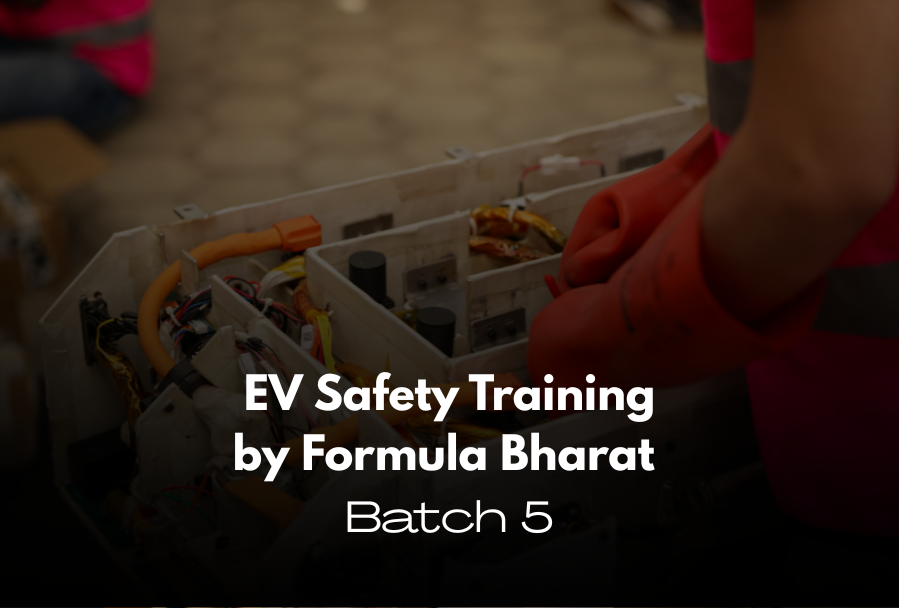
Formula Bharat invites students, faculty, and EV enthusiasts to register for its EV Safety Training Program, a certified course designed to equip participants with essential knowledge to safely handle electric vehicles in a Formula Student context.
This training aligns with the Formula Bharat 2027 requirements and is recognized by several international FS competitions. It is also a valid pathway to earn the Electrical System Officer Qualification (ESOQ) as required by Electric Vehicle Formula Student teams.
Course Levels Offered
- Stage 2E: Theoretical Training + Evaluation
- Stage 3E: Theoretical + Guided Practical + Evaluation
Certification
Participants who complete the training receive a recognized EV Safety Certificate, essential for compliance and safe EV operation.
Batch 5 Dates
Register by: October 22, 2026
Training: October 23, 2026
Batch 5 Details and Highlights
– DGUV 209-093 based training (2E & 3E)
– Supports Formula Bharat 2027 ESOQ requirements
– Applicable to Formula Bharat and several Formula Student competitions globally, subject to their current rule requirements
– Delivered by a qualified EV Safety Expert
– Special discounted fee for Formula Bharat 2027 participating team members
– The discounted fee is only for Formula Bharat 2027 participating team members. Members of Formula Bharat who are not a part of a Formula Bharat 2027 participating team can still avail the membership discount as mentioned in the EV Safety Registration and Payment Guide.
Ready to get certified?
For complete details and to register, visit: https://formulabharat.com/programs/ev-safety/
Register Now: Registration Form
Questions?
Contact: formulabharat@gmail.com
FSG Academy 2026 at Helsing in Munich

The annual FSG Academy will take place on Saturday, November 7th, 2026, at Helsing in Munich. The workshop opens the new season and brings Formula Student teams together with experienced FS participants, industry professionals and FSG officials. Attendance is limited to 250 participants.
Program
- 08:00 – 08:45 Registration
- 09:00 – 10:00 Highlight Speeches by Helsing
- 10:15 – 10:45 Rules
- 11:00 – 12:15 M- and A-Inspection / Statics by FSG
- 13:45 – 14:45 DV Cup Winner showcase by TU Hamburg
- 13:45 – 16:00 Team Captain Meeting with FSG officials (one person per team)
- 15:00 – 16:00 FSG Winner showcase by ETH Zürich / Technical Inspection Insights by FSG
- 16:30 – 17:30 E- and DV-Inspection by FSG / Lessons Learnt
- 17:30 – 18:15 Panel Discussion
There will also be time for networking during lunch and the Brezel Break. The full schedule is available as a PDF on the Academy page.
Registration
Registration opens on Saturday, October 3rd, 2026, 13:00 CEST at fsg.one/20261107. Any active team member can register.
- Until Saturday, October 10th, 13:00 CEST: up to 5 participants per team
- After that: remaining places without a team limit, first come, first served
- Registration and participant allocation close on Saturday, October 31st, 13:00 CET.
Good to know
- All talks will be held in English.
- The Academy is in-person only. There will be no livestream this year. As always, however, the talks will be recorded and will afterwards be freely available on the Academy webpage.
- The event takes place in two neighbouring buildings: Helsing and the House of Communication in Munich.
Dynamix 2027: Registrations Now Open!
After a thrilling debut season, Dynamix returns for its third edition, laser-focused on performance.
Dynamix 2027 is a unique event that puts the spotlight where it belongs: on the racetrack. Unlike traditional events, Dynamix leaves static evaluations behind and focuses purely on real-time, high-intensity on-track testing. Developed in the spirit of Formula Bharat, Dynamix lets your vehicle do the talking.
Teams will compete in a format that prioritizes documentation, build, compliance and endurance, offering a rare opportunity to:
- Benchmark your vehicle’s performance
- Test and refine your designs under race conditions
- Prove your team’s engineering on the tarmac
Whether you’re a returning contender or a first-time challenger, Dynamix is your stage to make every second count.
When & Where?
January 19–24, 2027
Kari Motor Speedway, Coimbatore
Alongside the Formula Bharat 2027 competition
Open to:
Combustion & Electric Vehicle categories.
Registrations Now Open! Learn more, view deadlines, access resources, and register at:
https://formulabharat.com/sub-events/dynamix-2027/
Formula Student Germany 2026
Formula Student Germany (FSG) 2026 has come to a successful close. From 11 to 16 August, the Hockenheimring became the focal point of an intense Formula Student season for around 3,000 students from 21 nations. After months of development, design and testing, the teams put their self-built electric vehicles and technical concepts to the test in the static and dynamic disciplines.
On and off the track, the broad range of Formula Student was once again on display: from the disciplines of Engineering Design, Cost & Manufacturing and Business Plan through to Acceleration, Skid Pad, Autocross and Endurance, it was not only results on the racetrack that were judged, but also the technical, economic and strategic decisions behind the prototypes.
Winning Teams 2026
Overall Winner of FSG 2026: ETH Zürich - Car 33
Overall 2nd place: RWTH Aachen - Car 99
Overall 3rd place: NTNU Trondheim - Car 63
Driverless Cup Winner 2026: TU Hamburg - Car 78
Driverless Cup 2nd place: NTNU Trondheim - Car 63
Driverless Cup 3rd place: ETH Zürich - Car 33
All results are available at: /fsg/results/2026
New "Vehicle Production Line" Concept
One of the innovations at FSG 2026 was the new "Vehicle Production Line" concept for the static disciplines Engineering Design and Cost & Manufacturing. For the first time, teams passed through six specialised stations together with their vehicle, while the respective judges remained at their specialist stations. The new format created clearly structured processes, improved the comparability of evaluations, and enabled a particularly focused technical exchange between teams and experts.
FSG as an Interdisciplinary Learning Platform
Since its founding, FSG has set standards: in 2010 as the first competition worldwide with its own electric class, in 2017 with the introduction of autonomous disciplines, and exclusively electric since 2024. FSG sees itself as a learning platform that connects young talent with industry and research, and actively promotes sustainable mobility concepts. This is by no means just about engineering: successful teams combine competencies from the most diverse fields of study – from classic mechanical engineering to computer science and design, through to business, media and communications. It is precisely this diversity that makes FSG a unique laboratory in which students from all disciplines collaborate in a practice-oriented way and bring their creativity to the mobility of the future.
FS Concept Challenge 2026 Registrations Are Now Open

Formula Student teams can now register for FS Concept Challenge 2026, a virtual engineering design competition that provides students with an opportunity to validate their vehicle concepts, receive expert feedback, and strengthen their engineering knowledge.
The FS Concept Challenge is designed to help teams develop a strong foundation in vehicle design, engineering analysis, project planning, and technical documentation. Participants will present their concepts to experienced industry professionals and judges, gaining valuable insights that can be applied throughout their Formula Student journey.
Whether you’re a first-year team building your inaugural race car or an experienced team looking to refine your design approach, FS Concept Challenge 2026 offers an excellent platform to learn, improve, and prepare for future Formula Student competitions.
Why Participate?
- Validate your engineering concepts with industry experts.
- Receive constructive technical feedback on your vehicle design.
- Improve your design, documentation, and presentation skills.
- Benchmark your work against Formula Student teams from across the region.
- Build a stronger foundation for the upcoming Formula Student season.
Registrations for FS Concept Challenge 2026 are now open. Secure your team’s place today and take the next step toward engineering excellence.
Handbook Update - BPEFS, Event Profiles and Multiple Race E-Keys
Dear Teams,
We recently published an update to the FSG Event Handbook 2026 at https://fsg.one/rules.
It contains the specification of what needs to be put into the Business Plan Executive & Financial Summary (BPEFS). In addition, the procedure for Engineering Design and Cost and Manufacturing, see https://n.fsg.one/1477, has now been added to the Handbook.
As we were, unfortunately, late with providing the Technical Vehicle System Documentation (TVSD) form, the Media Uploads (MU) and the information about the BPEFS, those three deadlines have been postponed as part of this update as well.
The updated Media Uploads, formerly known as Magazine Uploads, have now been activated. As part of this update, we have collected the information that your predecessors entered in previous seasons to display Event Profiles for every year that your team participated in Hockenheim. We are continuing to work on this feature, so stay tuned for some updates. In the meantime, enjoy some fond memories as you browse through these profiles.
DV teams, please note: to provide greater flexibility and to reduce dependencies in the schedule for you as a team but also for our setup, we want to utilize the second and third Race Mode on the RES with their respective Race E-Keys. Therefore, you need to wire the three Race Mode inputs via a multi-position (rotary) switch, instead of a flip switch. Teams that are unable to modify their switch or wiring may still run on the flip switch setup known from last year. Please be aware, though, that the Race Key 1 may not be available on all dynamic disciplines at all times. As a fallback, you may run on your Training E-Key.
FSG MathWorks Modeling and Simulation Award 2026
The FSG MathWorks Modeling and Simulation Award 2026 is designed to recognize and reward teams that effectively use MathWorks tools in the design and development of their electric and autonomous vehicles in the Formula Student Germany 2026 competition. The goal is to encourage teams to adopt industry-grade Model-Based Design practices and demonstrate how simulation supports engineering decisions.
The award determination process consists of two stages: evaluation of a detailed report and assessment of a formal presentation. Teams will be evaluated based on a simulation-driven case study that highlights how MATLAB and Simulink were used to support a key design decision, focusing on the modeling approach, insights obtained, resulting design changes, and validation with real-world data.
The top three teams that demonstrate the most effective use of MathWorks software will be honored at the Formula Student Germany 2026 award ceremony with cash prizes:
- 3,000 USD for the first place
- 2,500 USD for the second place
- 1,500 USD for the third place
To master Stage 1 the teams will need to submit a document in a PDF format to the organizers by July 26, 2026, 23:59 CEST. Please access all the details of the award in the attached PDF file.
MathWorks Point of Contact: Veer Alakshendra (valakshe@mathworks.com)
Introducing the Technical Vehicle System Documentation (TVSD)
With the release of the Technical Vehicle System Documentation (TVSD), a new approach to Design Judging documentation is introduced.
Over the past years, the main technical documentation used for Design Judging has been based on the Engineering Design Report (EDR) and the Design Specification Sheet (DSS). While both formats supported the evaluation process, they increasingly led to duplicated content and limited visibility of engineering reasoning. At the same time, the content provided by teams often became repetitive across seasons, and judges had to extract relevant information from varying styles and information depth of written design reports.
The TVSD replaces this setup with a single, structured documentation format. The new format combines quantitative data with engineering explanations in a consistent, system-oriented structure. All relevant judging categories are covered, allowing teams to present their engineering work coherently and enabling judges to efficiently access and evaluate the information prior to the judging sessions. To ensure continued relevance, selected content and questions can be adapted from season to season, reflecting technological developments while keeping the core structure stable. In addition to the main content, the TVSD includes a dedicated attachments chapter. This allows teams to include visualizations, figures, and supporting material to strengthen their technical arguments.
The TVSD is designed as a standardized format applicable to both Electric Vehicles and Combustion Vehicles. While specific technical sections can be adapted to the respective vehicle concept, the overall structure remains consistent. All information is entered through the FSG webpage-based tool and lets teams generate competition-specific PDF versions based on the same dataset. Teams can create exports tailored to competitions that use the FSG database, allowing the same technical content to be reused while meeting individual submission requirements.
In summary, the TVSD is a structured and scalable system for engineering design communication, improving transparency, comparability, and the overall quality of documentation for teams, judges, and competition.
Statics Judging Procedure Update for FSG 2026
Formula Student Germany introduces an updated statics judging procedure for Engineering Design and Cost & Manufacturing. The new concept aims to further improve efficiency, fairness, and the overall judging experience for both teams and judges.
Further details on team composition, scheduling, and permitted materials are outlined in the document now available under Rules & Important Documents.